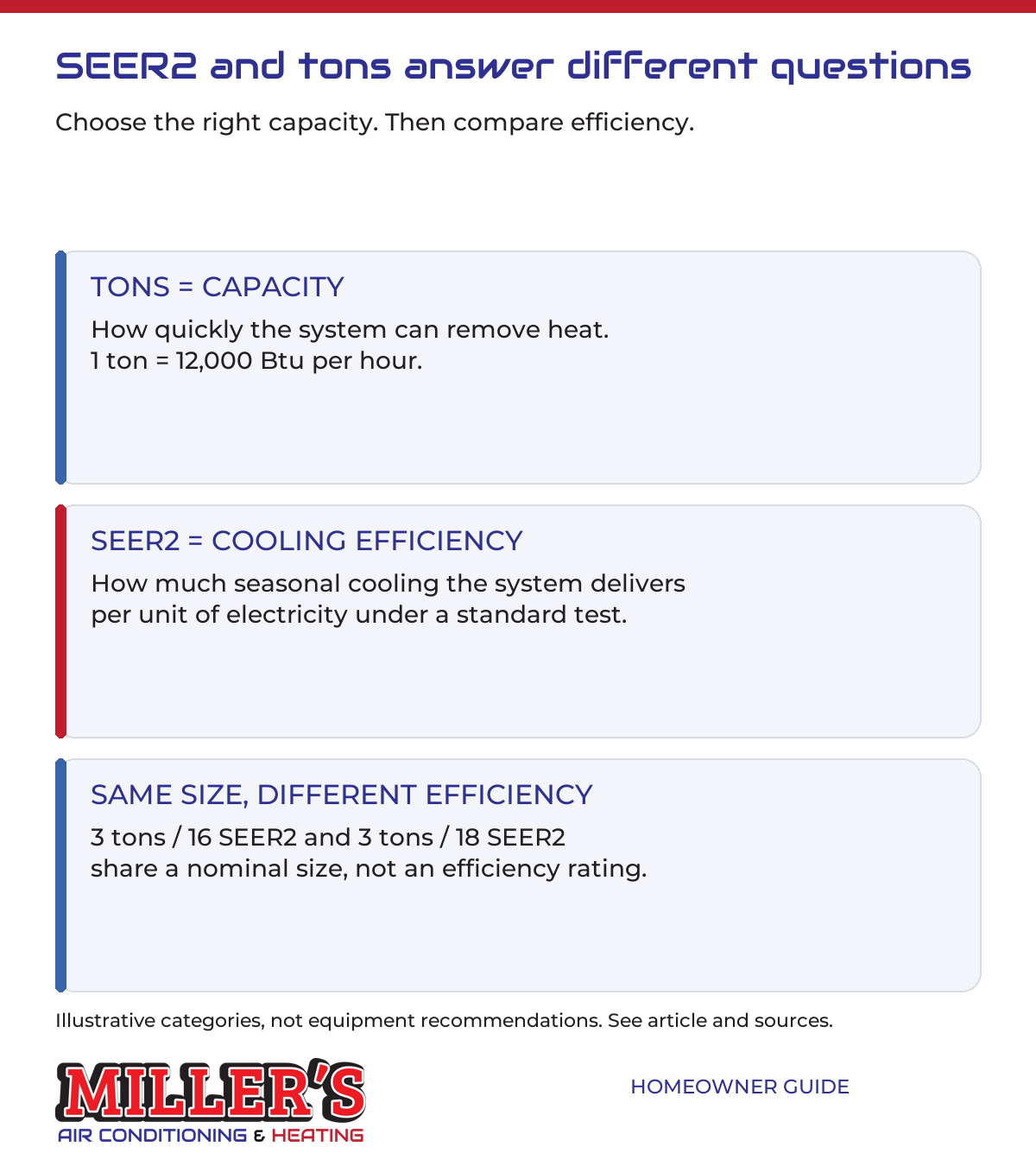
SEER2 tells you how efficiently a system cools. Tonnage tells you its cooling capacity.
It is late afternoon. The old system switches off. A replacement quote sits on the kitchen table.
The house is familiar, but the decision is new.
Before another summer arrives, you want to understand what comes next. What will fit your home? What is worth the extra cost?
You need the correct capacity first. Then compare efficiency and total cost.
What do the SEER2 numbers mean?
A familiar thermostat can lead to an unfamiliar page of numbers. Start with the cooling rating.
SEER2 means Seasonal Energy Efficiency Ratio 2. It is the current seasonal cooling rating for new residential central AC and air-source heat pumps.
The “2” identifies the revised test method. It does not mean two tons or two operating stages.
Numbers such as 14.3, 16, 18 and 20 show different efficiency levels. A higher number means more cooling per unit of electricity under standard tests.
| SEER2 rating | Calculated cooling electricity reduction compared with 14.3 SEER2 |
|---|---|
| 14.3 | Starting point |
| 15.2 | About 6% |
| 16 | About 11% |
| 18 | About 21% |
| 20 | About 29% |
| 22 | About 35% |
These examples assume equal cooling output. They do not predict your bill or describe available Miller’s equipment packages.
These ratings are not an installation-eligibility list. The exact system must meet applicable equipment, regional and current code requirements. DOE regional standards
For example, 18 SEER2 uses about 11% less cooling electricity than 16 SEER2 under these assumptions. This reduction does not apply to your entire utility bill.
Older systems can show SEER without the “2.” The test methods differ. Do not compare those numbers as if they were the same measurement. AHRI rating guidance
What does tonnage mean?
Think about the rooms you use each day. The new system must meet the needs of those rooms.
Tonnage describes cooling capacity, but it does not describe equipment weight or efficiency.
One ton equals 12,000 Btu per hour. Btu per hour measures how quickly the system can remove heat.
| Nominal system size | Cooling capacity equivalent |
|---|---|
| 1.5 tons | 18,000 Btu/hour |
| 2 tons | 24,000 Btu/hour |
| 2.5 tons | 30,000 Btu/hour |
| 3 tons | 36,000 Btu/hour |
| 3.5 tons | 42,000 Btu/hour |
| 4 tons | 48,000 Btu/hour |
| 5 tons | 60,000 Btu/hour |
These are size categories. Actual capacity changes with equipment combinations and operating conditions. Lennox tonnage definition
Example: A 3-ton 18 SEER2 system has a higher efficiency rating than a 3-ton 16 SEER2 system. Both have the same nominal size.
A 4-ton system has more nominal capacity. That does not make it the correct size for your home.
How does square footage relate to system size?
Square footage means floor area. Use the area the system will heat and cool, rather than adding an unconditioned garage or attic.
Two 2,000-square-foot homes can need different capacities. One may have shade and good insulation. The other may have large sunny windows and more air leaks. Insulation or window upgrades can also change the needs of the same rooms.
Ask for a Manual J load calculation. It estimates heating and cooling needs using floor area, ceiling heights, windows, insulation, air leaks and local weather. Room-by-room results help plan airflow where you need it. Manual J load guidance
There is no single square-feet-per-ton rule that fits every home. SEER2 is not a square-footage rating. Use calculated loads and equipment performance at local design temperatures to select capacity. Manual S guides this equipment-selection step. PNNL sizing and selection guidance
Also ask the contractor to check the ducts and select compatible equipment. Do not select capacity from floor area alone. PNNL sizing guidance
Is higher SEER2 worth the extra price?
It depends on your cooling use, electricity price and extra installation cost.
Think about both the next bill and the years you expect to stay.
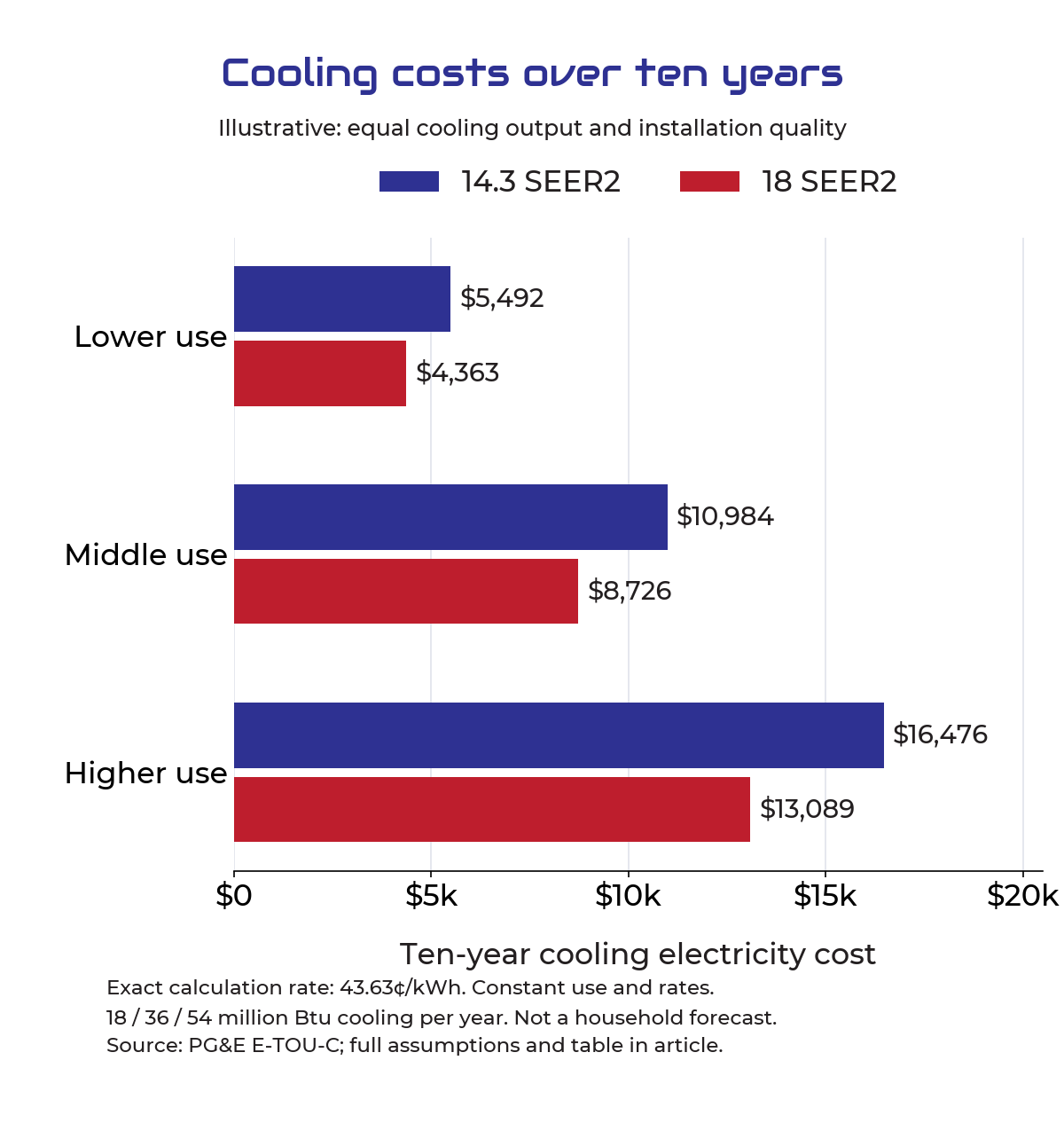
This example compares 14.3 SEER2 with 18 SEER2, using electricity at about 44¢ per kWh.
These are example costs, not a prediction for your home. Detailed assumptions are at the end.
| Example cooling use | Annual cost: 14.3 SEER2 | Annual cost: 18 SEER2 | Ten-year cooling savings |
|---|---|---|---|
| Lower use | $549 | $436 | $1,129 |
| Middle use | $1,098 | $873 | $2,258 |
| Higher use | $1,648 | $1,309 | $3,387 |
Suppose the higher-efficiency installation costs $2,000 more. This is an example difference, not a Miller’s quote.
- Lower use: Cooling savings do not recover the extra cost within ten years.
- Middle use: Cooling savings recover the extra cost in about nine years.
- Higher use: Cooling savings recover the extra cost in about six years.
In the middle example, five years of cooling savings total about $1,129. Consider how long you expect to stay.
Use your own electricity plan because the example rate will not match every home.
Compare SEER2 upgrade costs
The quote gives you a price for today. The system will also need care in the years ahead.
Also compare installation, maintenance, repairs, warranty coverage and loan charges.
In the middle example, cooling savings exceed the $2,000 upgrade cost by about $260 over ten years.
Now assume you borrow that extra $2,000 for five years at 8% annual interest. Interest adds about $430, with monthly payments and no fees. That removes the $260 advantage.
This is not a financing offer. Compare actual APR, fees and total payments. CFPB financing explanation
A higher SEER2 rating does not guarantee fewer repairs or a longer life. Do not treat unknown repair costs as zero.
What about heat-pump heating costs?
Then the season changes. The same rooms need warmth instead of cooling.
SEER2 measures cooling. Other ratings answer different questions:
| Rating | Meaning |
|---|---|
| EER2 | Cooling efficiency at a specified test condition. |
| HSPF2 | A heat pump’s seasonal heating efficiency under standard tests. |
| COP | Heat delivered per unit of electricity, using equal energy units, at stated conditions. |
| AFUE | The percentage of fuel energy a furnace converts to useful heat over a heating season. |
For example, COP 3 means three units of heat per unit of electricity. It does not mean that performance stays constant all winter. DOE heat-pump guidance, DOE furnace guidance
These examples supply the same amount of heat. The different rates and equipment performance change the cost.
| Heating example | Annual energy cost |
|---|---|
| Heat pump: seasonal average COP 3; electricity 35¢/kWh | $1,026 |
| Gas furnace: 95% AFUE; gas about $2.54–$3.04/therm | $801–$960 |
| Heat pump: seasonal average COP 4; electricity 30¢/kWh | $659 |
These are example energy costs only. Installation and other costs can change the result. See the assumptions below.
Considering a change in heating equipment? Our heat-pump planning guide explains the home assessment and installation scope.
A heat pump can cost more or less to heat with than gas. Check your home, equipment and rates first.
What should you ask before you buy?
Before you sign, return to the home behind the numbers. Use these questions to compare your choices.
Use our installation planning guide to check the assessment, included work and startup records before comparing final prices.
- What capacity does my home need?
- What is the SEER2 rating of the exact equipment combination?
- Does the price include necessary duct, electrical and installation work?
- What are the expected costs for my bills and length of ownership?
- What do the warranty and financing terms cover?
A lower purchase price can make sense with limited use or a short stay. Higher efficiency can make sense with more use and a reasonable extra cost.
You do not need to decide everything at the kitchen table tonight. Start with the right size, clear costs and answers you understand.
Then you can choose what comes next for the place you call home.
Pro tip
Compare the rating of the exact indoor and outdoor equipment combination. A brochure’s highest rating may describe a different combination.
Three actions to take
- Ask for the capacity calculation and exact equipment model numbers.
- Gather recent utility bills and note how long you expect to stay.
- Request the extra installed cost for higher efficiency, using the same work scope.
Comparing quotes in Livermore, Dublin or Pleasanton? Use Miller’s free HVAC quote comparison. Bring your proposals and recent utility bills.
Calculation details and sources
The main text uses rounded rates for easier reading. Calculations use the exact values below. Then dollar totals are rounded to whole dollars after calculation at full precision.
SEER2 cooling cost examples
- Annual cooling output: 18, 36 or 54 million Btu. These are examples, not local averages or system sizes.
- Equal cooling output, installation quality and duct performance for each equipment comparison.
- Assumed electricity use: 70% off-peak and 30% peak. This is not measured household use.
- PG&E E-TOU-C summer rates: $0.39940/kWh off-peak and $0.52240/kWh peak, without a baseline credit.
- Weighted calculation rate: $0.43630/kWh, shown as about 44¢ in the main text.
- Rates, use and performance stay constant for ten years. No equipment deterioration or early replacement is modeled.
- Formula: annual kWh ≈ annual cooling Btu ÷ (SEER2 × 1,000).
The retrieved electricity rate sheet is effective June 1, 2026. Your plan, credits and charges can differ. PG&E E-TOU-C tariff, sheet 2
If your bill includes Ava, combine the applicable generation and delivery charges correctly. Do not add Ava generation to PG&E’s full bundled price. Ava rate guidance
Purchase and financing examples
The extra $2,000 purchase cost is hypothetical. The cash comparison assumes equal other costs and excludes the time value of money.
The middle example leaves $257.78 after the extra purchase cost. This is shown as about $260.
The loan example finances only the extra $2,000. It assumes 8% fixed annual interest, 60 monthly payments and no fees. Calculated interest is $433.17, shown as about $430. It is not an available financing offer.
Heating examples
- Annual heating output: 30 million Btu, with equal distribution performance.
- Heat-pump assumptions: seasonal average COP 3 at $0.35/kWh, or COP 4 at $0.30/kWh.
- Furnace assumption: 95% AFUE.
- Gas rates: $2.53545/therm at baseline or $3.03857/therm above baseline. The main table rounds these rates.
- Gas rates exclude the separate public-purpose surcharge and taxes. Actual use can span both tiers.
- Examples exclude installation costs, furnace blower electricity and remaining gas service charges. No separate backup-heat use is included.
The retrieved gas rate sheet is effective November 1, 2026. Actual weather, defrost, backup heat and changing rates affect costs. PG&E G-1 gas tariff
Sources and calculations reviewed November 14, 2026.